
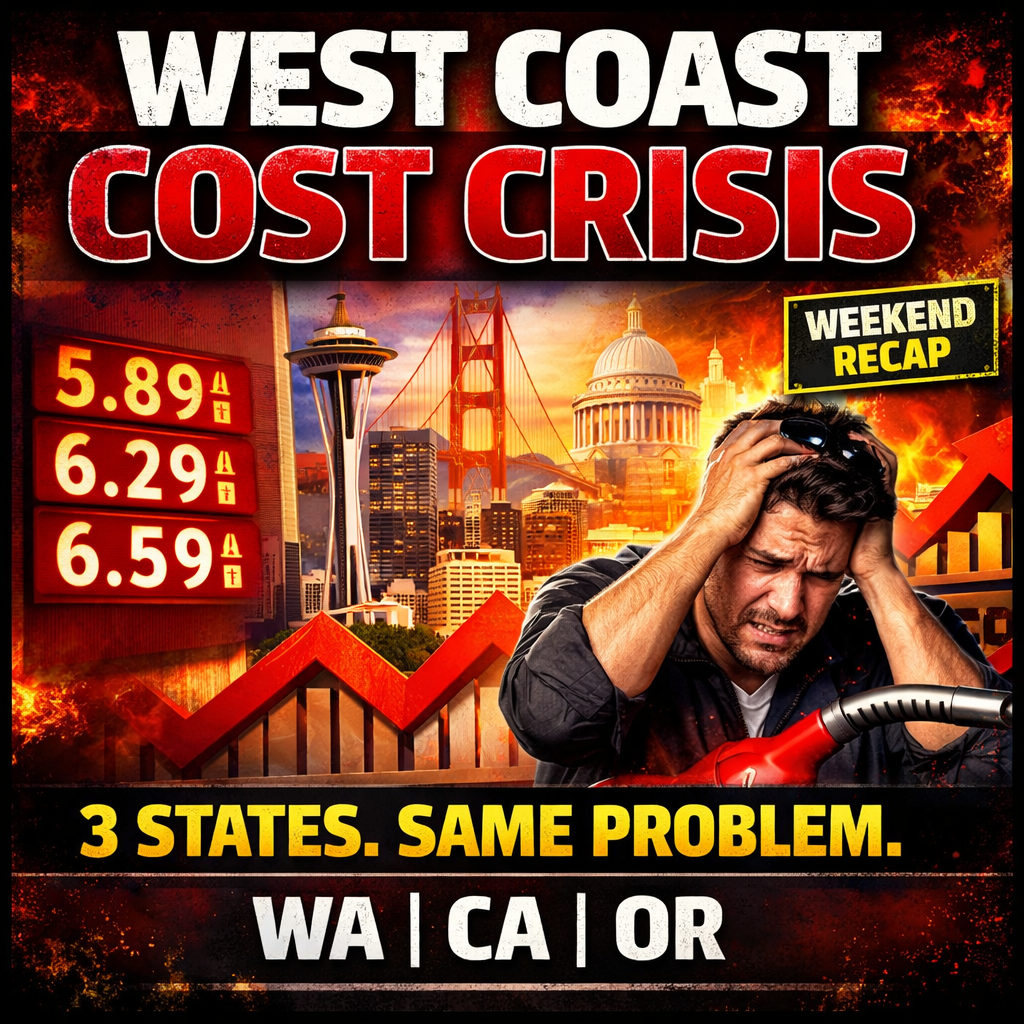
Our stories from the week of April 13th-17th
Rising Fuel Costs and Tariffs Push Washington Farmers to the Brink
By: Left Coast News
Farmers across Washington State are facing mounting financial pressure as record-high fuel prices and increased costs tied to tariffs strain already thin operating margins, raising concerns about the stability of local food production and broader supply chains.
According to a recent report from KING 5 News, many farmers say they are “running on empty,” pointing to diesel prices as a primary driver of rising expenses. Fuel is a critical input in nearly every stage of agricultural production, from planting and irrigation to harvesting and transportation.
“When diesel goes up, everything goes up,” one farmer told the outlet, reflecting a sentiment shared across the industry.
A Compounding Cost Crisis
Unlike other industries that can more easily adjust pricing or reduce output, agriculture operates on tight timelines and narrow profit margins. Farmers must absorb rising costs upfront, often months before seeing any return.
In Washington, the situation is intensified by a combination of factors:
-Elevated state fuel taxes
-Increased regulatory compliance costs
-Geographic reliance on long-distance transportation to processors and export terminals
These pressures are layered on top of global market conditions, including tariffs that have raised the price of imported equipment, parts, and supplies.
A National Trend Emerges
While Washington farmers are feeling the effects acutely, similar challenges are unfolding across the United States.
Producers in the Midwest are grappling with higher fertilizer and input costs, while California farmers continue to scale back operations amid water restrictions and rising expenses. Nationwide, diesel prices remain significantly higher than pre-2020 levels, contributing to a broader pattern of financial strain within the agricultural sector.
Economists warn that these overlapping pressures could lead to reduced domestic food production if conditions persist.
Implications for Food Prices and Supply Chains
The impact of rising farming costs extends beyond the agricultural sector.
When farmers cut back on production or delay investments, the effects ripple through the supply chain, potentially resulting in:
Increased grocery prices
Reduced availability of certain products
Greater reliance on imported food sources
Industry analysts note that while consumers may not immediately notice these changes, sustained cost pressures can gradually reshape supply dynamics.
“Food systems don’t break overnight,” one analyst said. “They weaken over time, and by the time it’s visible at the consumer level, the underlying issues have been building for years.”
Looking Ahead
In the coming months, much will depend on fuel price trends, trade policy developments, and whether any regulatory or financial relief is introduced.
For now, many Washington farmers say they are focused on staying afloat through the current season, even as uncertainty grows.
The long-term outlook, however, remains less clear.
As one farmer put it: “We’ll keep going as long as we can. But it’s getting harder every year.”
West Coast Pressures Mount as Gas Prices, Court Rulings, and Political Scandal Collide
By: Left Coast News
Residents across the West Coast are facing a convergence of economic pressure, legal uncertainty, and political controversy, as recent developments in Washington, Oregon, and California highlight broader concerns about governance, accountability, and cost of living.
Washington Gas Prices Spark Debate Over Causes
In Washington state, rising gasoline prices have become a renewed point of contention, with political leaders offering competing explanations for the sustained costs at the pump.
U.S. Representative Suzan DelBene recently pointed to global instability, including tensions involving Iran, as a contributing factor to increased fuel prices. Analysts generally agree that geopolitical events—particularly those affecting key oil transit routes such as the Strait of Hormuz—can influence global oil markets and lead to price volatility.
However, critics argue that this explanation overlooks a more consistent factor: Washington’s historically high baseline fuel costs.
The state has ranked among the highest in the nation for gas prices for several years, even during periods of relative global stability. Policy measures such as the state’s Climate Commitment Act, which requires fuel suppliers to purchase carbon allowances, have been cited as contributing to higher per-gallon costs. Estimates from industry and agricultural groups suggest the program may add roughly 50 cents or more per gallon, though figures vary depending on market conditions.
In addition, Washington’s gas tax—among the highest in the country—combined with low-carbon fuel standards and refinery compliance costs, has created a pricing structure that exceeds that of neighboring states such as Idaho and Oregon.
Supporters of the policies argue they are necessary to reduce emissions and fund environmental initiatives. Opponents counter that the cumulative effect has placed a disproportionate burden on consumers, particularly during periods of broader economic strain.
Oregon Wildfire Victims Face Legal Uncertainty
Meanwhile, in Oregon, survivors of the devastating 2020 Labor Day wildfires are confronting a new legal setback after the Oregon Court of Appeals reversed a landmark verdict against utility company PacifiCorp.
The original 2023 ruling found PacifiCorp liable for multiple fires—including the Santiam and Echo Mountain fires—and led to more than $1.2 billion in jury awards to affected residents. Thousands of additional claims were pending at the time.
In its April 2026 decision, the appeals court determined that jury instructions in the original trial were flawed, particularly regarding how evidence was applied across a broad class of plaintiffs representing multiple fires. The ruling effectively vacated the earlier decision and sent the case back for further proceedings.
For many victims, the reversal has introduced uncertainty at a time when financial compensation was expected to help rebuild homes and communities.
Some plaintiffs have already received substantial awards, while others were awaiting trial dates that are now in question. Attorneys representing victims have indicated they will seek review by the Oregon Supreme Court, which could decide in the coming months whether to hear the case.
Legal experts note that if the state’s high court declines to intervene, the litigation process could be significantly prolonged, potentially delaying relief for years.
California Congressman Resigns Amid Allegations
In California, political fallout intensified as Eric Swalwell announced his resignation from Congress following multiple allegations of sexual misconduct.
Swalwell, who had recently suspended his campaign for governor, faced mounting pressure from both parties after reports surfaced involving claims from a former staff member and additional individuals alleging inappropriate behavior.
The resignation marks a significant shift in the state’s political landscape, particularly given Swalwell’s previously strong position in early polling for the gubernatorial race.
While the allegations have not yet been adjudicated in court, the rapid political response reflects increasing scrutiny of public officials and the growing expectation of accountability in cases involving misconduct.
A Region Under Strain
Taken together, the developments underscore broader challenges facing West Coast states, where economic pressures, environmental policy, and institutional accountability continue to intersect.
In Washington, the debate centers on how much of the financial burden placed on consumers is driven by external forces versus state-level decisions. In Oregon, the legal system’s role in delivering timely justice to disaster victims remains under examination. And in California, political institutions are once again grappling with issues of ethics and public trust.
As these stories continue to unfold, residents across the region are left navigating the practical consequences—higher costs, delayed recovery, and shifting political dynamics—while policymakers and courts determine what comes next.
West Coast Policy Priorities Under Scrutiny as Washington Lawsuit Effort and California Parole Decision Draw Criticism
By: Left Coast News
A growing debate over government priorities on the West Coast is emerging following new data on Washington State’s legal efforts against the federal government and a controversial parole decision in California that has sparked widespread backlash.
Washington AG has logged more than 34,000 hours filing lawsuits against the Trump Administration
According to records obtained by The Center Square, the Washington State Attorney General’s Office has logged more than 34,000 staff hours working on lawsuits filed against the administration of Donald Trump since November 2024. More than two-thirds of those hours were billed within a six-month span.
The total represents the equivalent of approximately 1,416 full workdays, or nearly four years of continuous labor. Observers note that such a figure would typically represent the workload of dozens of attorneys operating at full capacity.
Jackson Maynard, executive director of the Citizen Action Defense Fund, told The Center Square that the volume of work is significant even for a large agency. He compared the effort to private-sector expectations, where attorneys often bill between 2,000 and 2,400 hours annually, suggesting the total workload could equate to roughly 100 lawyers working full time.
However, officials within the Attorney General’s Office maintain that the litigation is being handled by a much smaller team. Deputy Communications Director Mike Faulk stated that approximately 30 attorneys are currently assigned to the cases.
The lawsuits are part of a broader national trend. According to legal tracker data compiled by Just Security, a total of 758 lawsuits have been filed against the Trump administration during his second term. Of those, 338 remain pending, while 49 have been resolved, with outcomes split between plaintiffs and the federal government.
Supporters of the litigation argue the lawsuits are necessary to challenge federal policies and uphold state authority. Critics, however, question whether the scale of the effort reflects appropriate use of taxpayer-funded resources.
California Parole Board releasing serial child molester sentenced to 3 life terms.
Meanwhile, in California, a separate controversy has intensified scrutiny of state decision-making processes, particularly regarding public safety.
The California Board of Parole Hearings recently approved the release of David Allen Funston, a 64-year-old convicted in 1999 on multiple counts of kidnapping and child molestation. The decision was made under the state’s elderly parole program, which allows inmates over the age of 50 who have served at least 20 years to be considered for release.
The case has drawn strong opposition from law enforcement officials, prosecutors, and victims’ advocates.
Funston was originally sentenced to three consecutive life terms plus 20 years following a series of crimes involving eight children between the ages of three and seven. At the time of sentencing, a judge described him as “the monster parents fear the most.”
Former Sacramento County prosecutor Anne Marie Schubert, who handled the case, has called for further evaluation under California’s Sexually Violent Predator program, which could allow for continued confinement in a state hospital rather than release into the public.
Sacramento County Sheriff Jim Cooper publicly criticized the parole decision, stating that individuals responsible for such crimes should not be considered for release. Other law enforcement officials involved in the original investigation have also expressed concern, emphasizing the lasting impact on victims.
Governor Gavin Newsom requested a review of the parole decision; however, the Board reaffirmed its ruling in February 2026. The governor ultimately did not intervene to block the release.
The California Department of Corrections and Rehabilitation has not publicly disclosed the exact timing or location of Funston’s release, citing security concerns.
Together, the developments in Washington and California have fueled broader discussions about governance, resource allocation, and public safety across the region.
While the issues stem from different policy areas—legal challenges in one state and criminal justice decisions in another—both have prompted renewed attention to how state institutions prioritize their responsibilities.
As these debates continue, officials and voters alike may face increasing pressure to evaluate whether current policies align with public expectations on accountability, safety, and the use of government resources.
- Gavin Newsom’s FBI Problem: The Wiretap, Guilty Plea & Money Trail
- Gavin Newsom’s FBI Problem: The Wiretap, Guilty Plea & Money Trail
- Washington DCYF EXPOSED: $117M+ in Blunders, Corruption & Taxpayer Waste | Green Hill Crisis
- The School Budget Collapse: Inside the $50M Portland Public Schools Disaster
- WA Supreme Court Candidate Karim Merchant on Gun Rights, Taxes & Judicial Accountability | Exclusive Interview
 Behind The Line Podcast
Leave a comment