
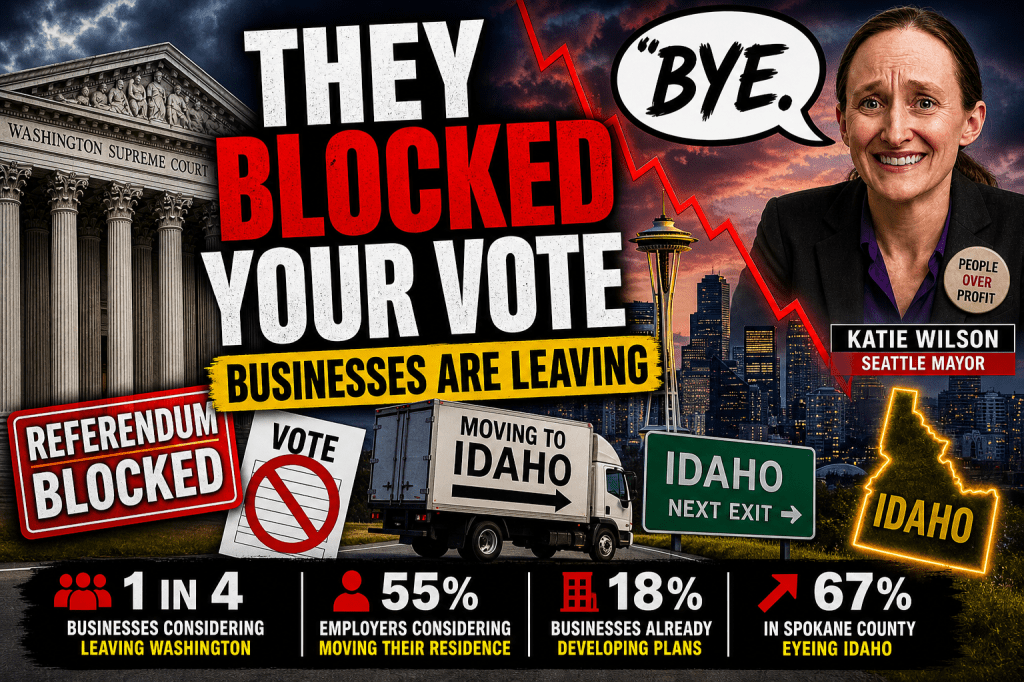
Washington Supreme Court Blocks Income Tax Referendum as Business Exit Concerns Grow
By John W | Left Coast News
OLYMPIA, Wash. — The Washington State Supreme Court has blocked an effort to place the state’s controversial new high-earner income tax before voters this November, handing a major victory to Democratic lawmakers while intensifying concerns from businesses already questioning the state’s economic direction.
In a ruling issued Monday, the Court rejected a referendum effort led by Let’s Go Washington, finding that the tax legislation falls under the constitutional exemption for laws “necessary for the support of the state government.”
Chief Justice Debra Stephens wrote that the law qualifies under Article II, Section 1 of the Washington Constitution, which shields certain legislation from referendum challenges when deemed necessary to support government operations.
The decision immediately changes the political landscape surrounding the tax.
Instead of pursuing a referendum requiring roughly 154,000 signatures, opponents must now launch a full statewide initiative campaign requiring more than 300,000 valid signatures by July 2.
Critics argue the ruling represents another example of Olympia using constitutional loopholes to insulate controversial legislation from direct voter review.
“This is exactly why people are losing trust in the process,” said tax opponent Brian Heywood, who has described the Legislature’s repeated use of the clause as a “blank check” for one-party rule.
The “Necessity Clause” Debate
The constitutional clause at the center of the dispute has become increasingly controversial in Washington politics over the last two decades.
Originally intended for emergencies involving public safety or immediate government operations, the provision has increasingly been attached to politically sensitive legislation ranging from taxes to energy policy.
The clause allows lawmakers to exempt legislation from referendum if the bill is declared necessary for:
Public peace
Public health
Public safety
Support of state government and existing public institutions
The final category has proven especially broad.
Critics argue lawmakers have effectively transformed it into a referendum-proofing mechanism.
Among the most notable past examples:
The 2021 Capital Gains Tax
Public financing for the Mariners stadium project in 1995
HB 1589, aimed at transitioning Puget Sound Energy away from natural gas
In many cases, opponents argued there was no immediate emergency requiring suspension of referendum rights.
However, a pivotal 2005 Washington Supreme Court ruling significantly shifted judicial interpretation toward deference to the Legislature. Since then, courts have generally accepted lawmakers’ declarations that revenue-generating bills are necessary to support government operations.
Supporters argue the clause ensures government stability and prevents disruption of essential funding mechanisms.
Opponents counter that the practice undermines one of the few direct checks voters have on state power.
Businesses Warn of Economic Fallout
The legal ruling arrives as new economic warning signs emerge across Washington’s business community.
A recent survey conducted by the Association of Washington Business (AWB) suggests growing anxiety among employers over the state’s tax and regulatory climate.
According to the survey:
One in four Washington businesses is now considering leaving the state
Fifty-five percent of employers are considering moving their personal residence
Eighteen percent are already developing relocation plans
Forty-four percent are consulting tax professionals
In Spokane County, sixty-seven percent of surveyed businesses are looking toward Idaho
The survey comes after lawmakers approved roughly $9.4 billion in new taxes and fees since 2025.
AWB President Kris Johnson warned that lawmakers should not dismiss relocation concerns as political rhetoric.
“The wheels are already in motion for many employers,” Johnson said.
Particular concern surrounds “pass-through” businesses, where company income flows directly onto owners’ personal tax returns. Critics argue that despite being framed as a “millionaire’s tax,” the policy could affect small and mid-sized businesses relying on retained earnings for expansion, hiring, or operational growth.
The survey identified the top business concerns as:
1. Tax burden
2. Health care costs
3. Government regulation
Seattle Mayor’s Remarks Draw Attention
The debate intensified further following remarks from Seattle Mayor Katie Wilson during a Seattle University event earlier this month.
Wilson dismissed claims that wealthy residents and businesses would flee Washington over progressive taxation policies.
“I think the claims that millionaires are going to leave our state are, like, super overblown,” Wilson said. “And if the ones that leave, like, bye.”
The comments quickly circulated online and drew criticism from business leaders and economic commentators already concerned about Seattle’s competitiveness.
Critics pointed to Starbucks’ recent decision to relocate approximately 2,000 jobs to Nashville as evidence that corporate migration is becoming more than a theoretical concern.
Seattle currently carries one of the highest combined sales tax rates in the nation at 10.35%, while commercial real estate vacancies and public safety concerns continue to challenge the downtown recovery effort.
Despite the backlash, Wilson has indicated support for exploring additional progressive taxation measures at the local level.
Broader Questions for Washington’s Future
The clash between Olympia lawmakers and business groups reflects a broader debate unfolding across several West Coast states.
Supporters of progressive taxation argue Washington’s wealthiest residents and corporations should shoulder a larger share of public funding responsibilities, particularly amid rising housing, infrastructure, and social service costs.
Opponents warn that excessive taxation and regulatory expansion risk undermining the economic engine that generated the state’s prosperity in the first place.
For now, the legal battle over Washington’s new income tax may be settled temporarily.
But the larger political and economic fight appears far from over.
As initiative supporters race against the July deadline, business leaders and policymakers alike are watching closely to see whether Washington’s increasingly aggressive tax posture will reshape the state’s long-term economic trajectory.
Because the question now extends beyond one tax bill.
It is whether Washington’s leadership accurately understands where the tipping point actually is.
#WashingtonState #Seattle #Olympia #IncomeTax #WashingtonPolitics #KatieWilson #WashingtonSupremeCourt #BusinessExodus #Idaho #Taxpayer #LeftCoastNews #Politics #Economy #SeattlePolitics #TaxBurden #WashingtonBusiness #Constitution #AWB #Spokane #PacificNorthwest
- American Students Pay Double While Non-Citizens Get Discounts?
- Massacre in Kenscoff: How Haiti’s Gang Cartels Are Hunting Christians
- The Venezuela Oil Deal: What the Media Left Out
- How HOAs Legally Steal Your Home (WA, OR, CA Property Rights Crisis)
- Oregon Veteran Sued for $10M After Shooting Intruder
 Behind The Line Podcast / Left Coast News
Leave a comment