A Sanctuary Torched: How Gang Terror and the War on Haiti’s Churches Exposed a Collapsing State
PORT-AU-PRINCE, Haiti — For years, the farming community of Kenscoff, perched high in the pine-covered hills above Port-au-Prince, offered an escape from the lawlessness consuming the valleys below. As heavily armed criminal cartels systematically overran 85 to 90 percent of Haiti’s capital, thousands of displaced civilians made the trek up the mountain, seeking refuge inside the courtyard and sanctuary of the Ark of the New Testament Evangelical Church.
Late on the night of August 23, the sanctuary was pierced.
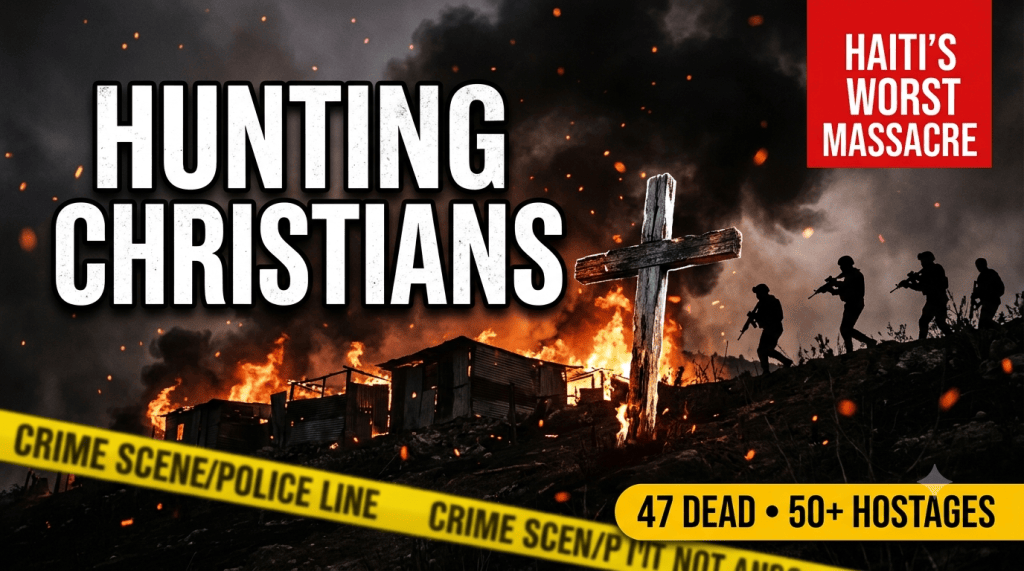
An estimated 150 fighters affiliated with Viv Ansanm—a unified cartel confederation designated by the United States as a foreign terrorist organization—swept through Kenscoff with assault rifles, machetes, and incendiary devices. Over the course of a six-hour rampage, the attackers reduced 25 homes to ash, executed municipal workers and local security personnel, and targeted the displaced families sheltering inside the church’s prayer center.
According to United Nations human rights investigators and municipal authorities, at least 47 people were killed, including five children. Twenty-two victims were executed in cold blood inside the church compound, and another dozen were gunned down as they attempted to flee into the brush behind the altar. More than 50 residents were marched into the surrounding mountains at gunpoint in one of the largest mass abductions in recent Haitian history.
Days later, a gang commander identifying himself as “Izo 2″—an operational lieutenant linked to warlord Johnson André—published a video across social media directed at Vladimir Paraison, the Director General of the Haitian National Police. Surrounding himself with terrified hostages, the commander delivered an ultimatum: halt all tactical drone operations and police counteroffensives into the hills, or the captives would be slaughtered.
Although UNICEF later confirmed that 13 captives (seven women and six children) were released, dozens remain unaccounted for in the mountains.
The slaughter in Kenscoff is not an isolated atrocity. It marks a critical turning point in Haiti’s multi-year security implosion: an overt, strategic offensive by criminal warlords to crush the Christian church, push into previously secure rural corridors, and exploit the near-total collapse of state authority just 700 miles off the coast of Florida.
The War on the Faithful: Eradicating the Last Institutional Bulkhead
In a country where executive, legislative, and judicial institutions have almost entirely ceased to function, religious bodies have found themselves directly in the crosshairs of gang expansion.
“We are the last remaining bulkhead—moral, ethical, spiritual, and prophetic,” Bishop Joseph Gontrand Décoste of the Diocese of Jérémie noted in an assessment of the security crisis. “That is why they want to eliminate us.”
Churches across Haiti serve as the primary network operating medical clinics, orphanages, emergency food distribution points, and schools in neighborhoods abandoned by the state. For gang leaders seeking total territorial dominance, religious autonomy represents an unacceptable center of resistance.
The consequences for clergy, missionaries, and congregants have been severe:
* Targeted Murders: In May 2024, American missionaries Davy and Natalie Lloyd—a young married couple working for Missions in Haiti Inc.—were ambushed alongside local mission director Jude Montis as they left a church youth group in Lizon. Gang gunmen cornered the trio, executed them, and set their bodies ablaze.
* Mass Hostage-Taking: In October 2021, the 400 Mawozo gang intercepted a bus carrying 17 missionaries from Christian Aid Ministries (16 Americans and one Canadian, including five children and an eight-month-old infant), holding them captive for two months under a $17 million ransom demand before the remaining hostages executed a midnight escape.
* Institutional Closures: In metropolitan Port-au-Prince alone, roughly 40 Catholic parishes and dozens of Protestant churches have permanently closed or suspended Sunday liturgies after cartel snipers established firing positions overlooking church doors and pastors were abducted mid-sermon on live-streamed broadcasts.
Gangs view religious congregations as prime sources of liquidity. By kidnapping pastors, dual-national churchgoers, and humanitarian staff, cartels extract high-dollar ransoms from foreign diaspora communities to finance weapon and ammunition procurement.
Anatomy of a Failed State: How the Capital Was Lost
Haiti’s slide into open gang warfare was accelerated by a rapid sequence of political decapitations and institutional collapses.
July 7, 2021: President Jovenel Moïse assassinated; constitutional succession breaks down.
│
January 2023: Terms of last remaining elected senators expire; zero elected officials in office.
│
Late 2023: Rival cartels (G9 & G-Pèp) unite under Jimmy “Barbecue” Chérizier into “Viv Ansanm”.
│
Feb–March 2024: Insurgency storms prisons, freeing 4,000+ felons; Prime Minister Ariel Henry ousted.
│
August 2026: Viv Ansanm offensive pushes into rural mountain sanctuaries, attacking Kenscoff church.
For decades, political factions and business elites in Port-au-Prince funded and armed neighborhood street gangs to manipulate elections and suppress working-class neighborhoods. Following Moïse’s assassination, the political system fractured completely. By early 2023, the terms of the last remaining elected senators expired without elections, leaving an unelected caretaker administration under Prime Minister Ariel Henry with no constitutional mandate.
Recognizing their leverage, rival street gangs made a historic tactical pivot. In late 2023, former police officer turned warlord Jimmy “Barbecue” Chérizier orchestrated an alliance between the warring G9 and G-Pèp federations, founding Viv Ansanm (“Living Together”).
In February and March 2024, while Henry was abroad in Nairobi negotiating foreign police deployments, Viv Ansanm launched a synchronized rebellion. They assaulted the Toussaint Louverture International Airport, set fire to dozens of police substations, and breached the National Penitentiary and Croix-des-Bouquets prison—releasing more than 4,000 violent inmates back into the streets.
Henry was forced to resign, and the cartels cemented control over commercial shipping terminals, fuel depots, and national highways, cutting off the capital from food, clean water, and fuel.
The U.S. Connection: The Iron Pipeline and Cross-Border Extortion
While the violence unfolds on Caribbean soil, the logistical and financial infrastructure sustaining Haiti’s warlords runs directly through the United States.
Haiti manufactures no domestic firearms or ammunition. Federal law enforcement investigations confirm that between 80 and 90 percent of the military-grade hardware recovered from Haitian gang members—including AR-15 rifles, AK-47 variants, and belt-fed .50-caliber anti-materiel rifles—is smuggled out of ports in South Florida.
The pipeline relies on a network of domestic straw-purchasers, corrupt freight forwarding services, and front companies operating in Miami, Fort Lauderdale, and Orlando.
A high-profile blueprint of this network emerged during the federal prosecution of Joly “Yonyon” Germine, the imprisoned leader of the 400 Mawozo gang, and his Florida-based associate Eliande Tunis. Operating from Pompano Beach, Tunis laundered ransom payments extorted from kidnapped Americans to buy dozens of high-powered tactical rifles at Florida gun stores, concealing them inside commercial shipping containers disguised as clothing and auto parts bound for Port-au-Prince. Germine was subsequently extradited to the U.S. and sentenced to 35 years in federal prison.
Beyond weapons trafficking, Haitian cartels maintain operational reach inside diaspora hubs across the U.S. East Coast—including Miami, Orlando, Brooklyn, Boston, and Atlanta—using established domestic street gangs like Zoe Pound (Zoe Mafia Family) for narcotics distribution, local extortion, and funneling illicit capital back to parent organizations in the Caribbean.
[ U.S. FIREARMS & CAPITAL PIPELINE ]
U.S. Straw Buyers (FL Gun Shops/Shows)
│
▼
Freight Forwarders / Port of Miami
│ (Illicit maritime smuggling)
▼
Haitian Ports (Varreux / Port-au-Prince)
│
▼
Viv Ansanm & 400 Mawozo Gang Cells
│
▼
Mass Kidnappings & Extortion Operations
│
▼
Ransom Wires / Crypto back to U.S. Intermediaries
The Foreign Policy Dilemma: Why Washington Keeps Combat Boots Off the Ground
Despite Haiti lying barely two hours by air from Miami, the United States has adamantly refused to deploy American combat forces to clear out the gangs, relying instead on financial underwriting, logistical transport, and international surrogates.
Foreign policy analysts and military strategists point to four primary factors driving this restraint:
1. The Peril of Asymmetric Slum Warfare
Clearing an estimated 200 heavily armed gang cells from dense, maze-like urban slums such as Cité Soleil or Martissant presents an urban counter-insurgency nightmare. Gangs routinely fight from within schools, clinics, and residential rooftops, using women and children as human shields. Any large-scale foreign assault carries a severe risk of immense civilian casualties.
2. Deep Historical Scars
Direct U.S. military intervention in Haiti carries deep historical baggage that gang leaders exploit for political propaganda:
* The 1915–1934 U.S. Occupation left enduring nationalist resentment.
* The 1994 Operation Uphold Democracy restored temporary governance, only for the political structure to collapse shortly after U.S. forces departed.
* The UN MINUSTAH peacekeeping mission (2004–2017) suffered catastrophic reputational damage when peacekeepers accidentally introduced a cholera strain that killed nearly 10,000 Haitians.
The moment foreign troops land, cartel commanders like Jimmy Chérizier reposition themselves from violent extortionists to anti-imperialist “patriots” leading a national resistance.
3. The “You Break It, You Own It” Quagmire
Neutralizing cartel leadership solves only the kinetic half of the equation. With no elected president, no functioning legislature, and a decimated judicial bench, any occupying foreign military force would be forced to assume daily civilian governance, border security, and civil infrastructure management with no viable exit strategy.
4. Zero Domestic Political Appetite
Following two decades of costly nation-building campaigns in Iraq and Afghanistan, there is virtually no domestic political appetite across either major American political party to commit U.S. troops to a protracted urban conflict in the Caribbean.
Instead, Washington has funded and supported the United Nations-backed Gang Suppression Force (GSF)—a multinational security mission designed to scale up to 5,550 personnel, drawing police and military contingents from Kenya, Chad, Benin, and CARICOM nations. However, deployments have lagged behind schedule, leaving a force of fewer than 1,500 foreign personnel to assist an exhausted, outgunned Haitian police force of approximately 9,000 active officers attempting to secure a population of 11 million.
The Gathering Storm
As the UN Security Council convenes emergency briefings in New York to accelerate the deployment of the Gang Suppression Force, conditions on the ground continue to deteriorate. The International Organization for Migration (IOM) estimates that more than 1.5 million Haitians are now internally displaced, while over half the nation faces acute malnutrition.
In Kenscoff, the charred sanctuary of the Ark of the New Testament Evangelical Church stands as an open symbol of a nation pushed past the brink. With cartel cells entrenching their positions across the surrounding hills and dozens of churchgoers still held captive in the brush, Haiti’s crisis has evolved beyond a domestic breakdown—posing an immediate, unresolved security test for the entire Western Hemisphere.
#Haiti #HaitiNews #KenscoffMassacre #HaitiChurchAttack #VivAnsanm #HaitiGangs #HaitiCrisis #JimmyCherizier #HaitiKidnapping #ArkOfTheNewTestament #ChristianPersecution #WarOnFaith #FailedState #LawAndOrder #CaribbeanSecurity #GangSuppressionForce #TransnationalCrime #USGunPipeline #FloridaSmuggling #400Mawozo #BorderSecurity #NationalSecurity #ForeignPolicy #TrueCrime #InvestigativeJournalism #BehindTheLine #BreakingNews #GlobalSecurity #HostageCrisis #RuleOfLaw
- American Students Pay Double While Non-Citizens Get Discounts?
- Massacre in Kenscoff: How Haiti’s Gang Cartels Are Hunting Christians
- The Venezuela Oil Deal: What the Media Left Out
- How HOAs Legally Steal Your Home (WA, OR, CA Property Rights Crisis)
- Oregon Veteran Sued for $10M After Shooting Intruder
 Behind The Line Podcast / Left Coast News
Leave a comment