
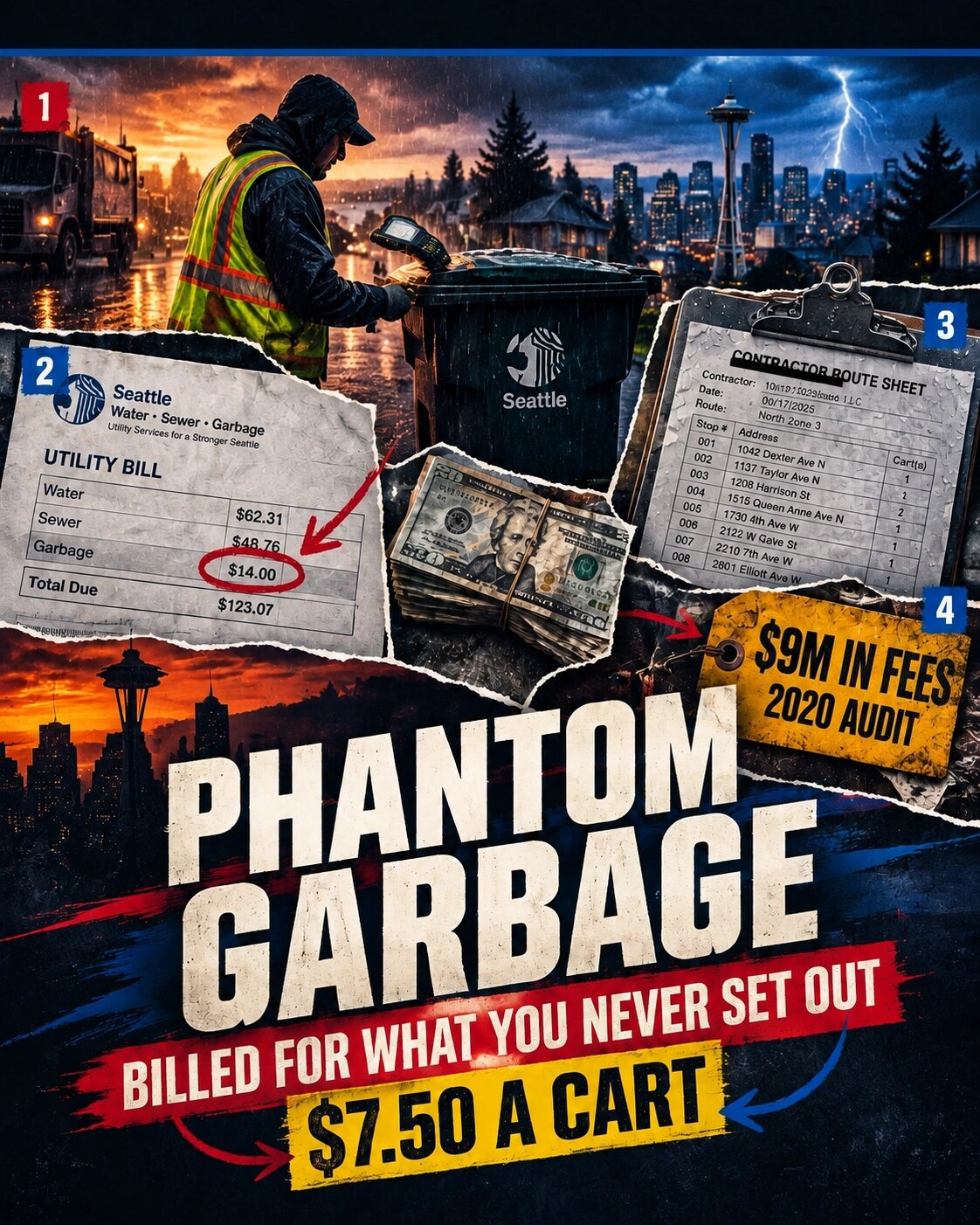
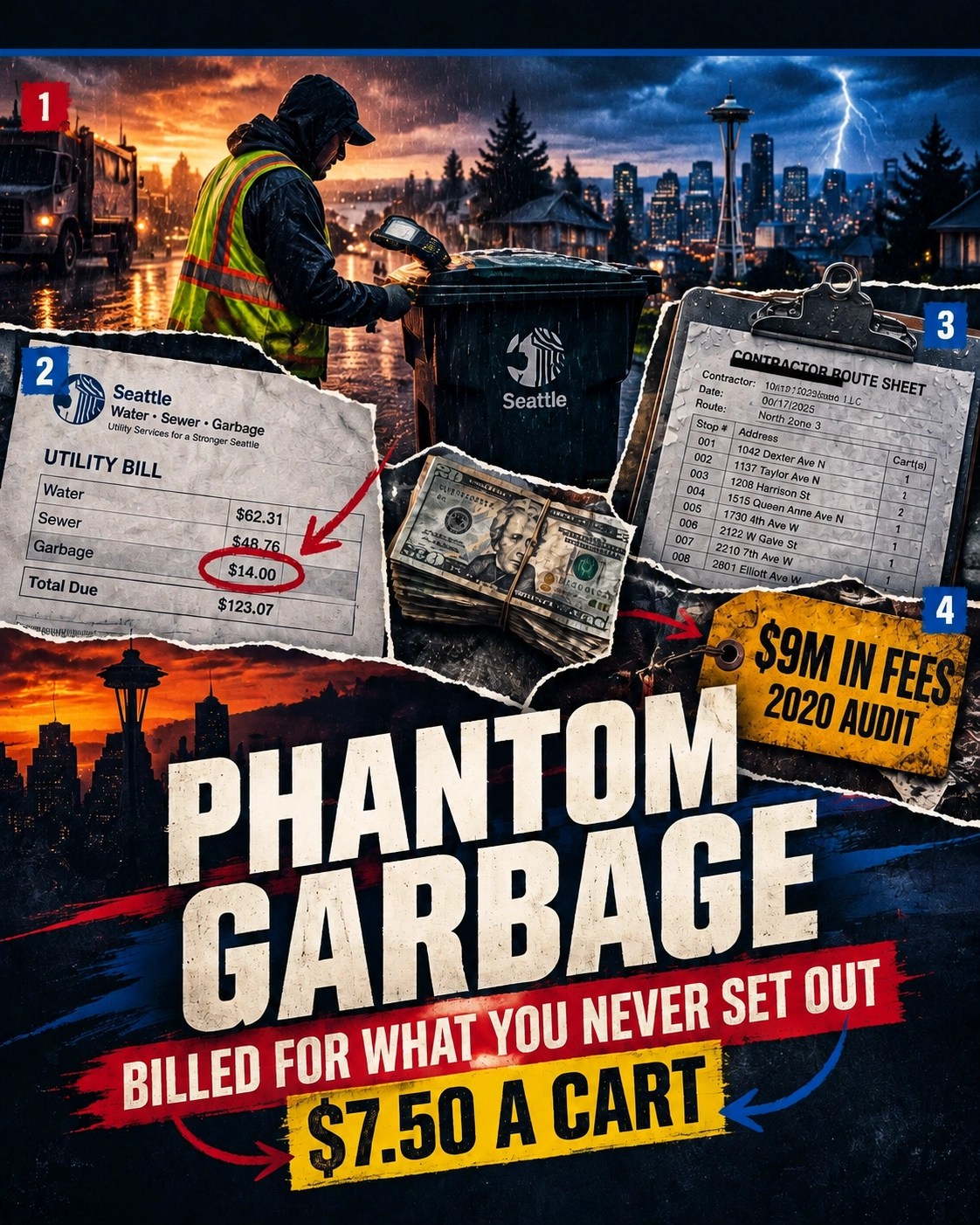
Four Seattle residents have filed a tort claim against the city over garbage and yard waste charges they say they were billed for and never set out. The claim is the step before a class action. It does not mean anything has been proven, and it is not a lawsuit.
The claim centers on Seattle Public Utilities and how extra-waste charges land on a bill. Those charges come from contractor reports filed by Recology and Waste Management, often in $7.50 or $14 increments. The claimants say the small line items added up to hundreds of dollars over several years.
That is the part worth your attention. If you have ever looked at a utility bill and found a charge you did not expect, you already know how hard it is to reconstruct what happened on a Tuesday morning six months ago.
What the claim alleges
The claim alleges that Seattle Public Utilities billed the four residents for extra garbage and yard waste they never set out for collection. The charges were generated from contractor reports, not from anything a city employee observed at the curb. Recology and Waste Management collect in Seattle, and their drivers document what they find.
Most of the individual charges are small. A single extra can or bag can show up as $7.50. A larger overage can show up as $14. Multiplied across months and years, the claimants say the total reached into the hundreds of dollars.
Nothing in the claim asserts that any employee acted in bad faith, and no court has reviewed the allegations. Seattle Public Utilities declined to comment. Recology and Waste Management did not respond to requests for comment.
This is not a small number of charges
The city logged more than 342,000 extra-waste charges in 2025. That is a lot of small line items. Each one is a judgment made at the curb by a driver with a route to finish, then coded into a billing system that most customers never see in detail.
The money adds up too. A 2022 City Auditor report put Seattle Public Utilities’ extra-waste fees at $9 million in 2020. That is not a rounding error in a household budget. It is also not, by itself, evidence that anything was billed wrongly.
What the September audit found
A solid-waste audit published in September 2026 looked at how the utility handles these charges. It found that Seattle Public Utilities did not review whether extra charges on commercial bills were appropriate. It also found the utility did not examine the contractors’ extra-waste reports.
The auditors recommended that the utility monitor those charges. Seattle Public Utilities disagreed, citing cost and staffing. The utility said it would keep relying on customers to flag charges they believe are wrong.
Read that again, because it is the whole story in one sentence. The agency that bills you has decided that the cheapest way to catch billing errors is for you to catch them.
The burden lands on the customer
Andrew Ackley, the attorney involved in the claim, put the problem plainly.
“The way to solve a systemic problem is not to put the burden on every single consumer to dispute every seven or $14 charge.”
He has a point that does not depend on whether these four claims are correct. A $7.50 charge is small enough that most people will not spend an afternoon on it. That is exactly why a system that depends on disputes tends to collect charges nobody checks.
We are not saying the charges were wrong. We are saying the review process, as the auditors described it, was not built to find out.
What a tort claim actually is
A tort claim is a formal notice that you intend to sue a government entity. In Washington, you generally have to file one before you can file a lawsuit against a city. It starts a clock.
State law gives the city 60 days to respond before anything can be filed in court. That means the next visible step is not a filing. It is either a response from the city, a denial, or silence followed by a decision about whether to go to court and seek class status.
So the timeline to watch is short and quiet. Sixty days from filing, then whatever the claimants decide to do next.
What you can do with your own bill
You do not need a lawyer to check your own charges, and you do not need to wait for this claim to play out.
Pull twelve months of bills and look for the extra-waste line items. Note the dates and the amounts. If a charge is attached to a week when you know what you set out, write it down while you remember. Photos of your cart on collection morning, dated, are worth more than a recollection later.
Then dispute it in writing, not by phone. Ask for the specific date of the charge, what was reported, and which contractor reported it. Keep a copy of the request and the response. A written record is the only thing that travels well if the charge turns out to be part of a pattern.
And be specific in what you ask for. “I think this is wrong” is easy to close. “On March 4 I set out one can, the charge says two extra units, here is the photo” is harder to wave off.
What we are watching
Three things. Whether the city responds within the 60 days or lets the clock run. Whether the utility changes how it reviews contractor reports, given that its own auditors flagged the gap and it declined the recommendation. And whether the City Council asks for the underlying charge data for 2025, the 342,000 charges, broken out by address and contractor.
That last one is the test. If the city will not produce the data, the public cannot check the pattern. If it will, everyone gets to see whether the dispute rate matches the billing rate.
We will follow the claim through the 60-day window and report what the city says, or does not say, when it answers.
Reported with information from KOMO News, 19 November 2026.
Left Coast Watch covers public safety, infrastructure and government accountability across Washington, Oregon and California every week. It is $5 a month with the first week free.
This article is for research and awareness, not legal advice and not a real-time alert. If you believe you were billed incorrectly, contact Seattle Public Utilities and keep your records.
#Seattle #Washington #SeattlePublicUtilities #UtilityBilling #GovernmentAccountability #ConsumerRights #Recology #WasteManagement #SolidWaste #PublicRecords #LeftCoastNews

Leave a Reply